Some hems are features in their own right. A turn-up (cuff) adds weight and a formal or vintage look. A churidar ankle closes snugly round the foot with a small placket. A raw edge frays on purpose. A growth hem lets a child’s trouser be let down as the child grows. This lesson covers all four, plus the salwar’s ankle band (mohri).

What you’ll learn
- How to cut and sew a trouser turn-up.
- How to finish a churidar ankle with a placket and hooks or buttons.
- How to sew a salwar ankle band (mohri).
- How to make a deliberate raw edge, and a children’s growth hem.
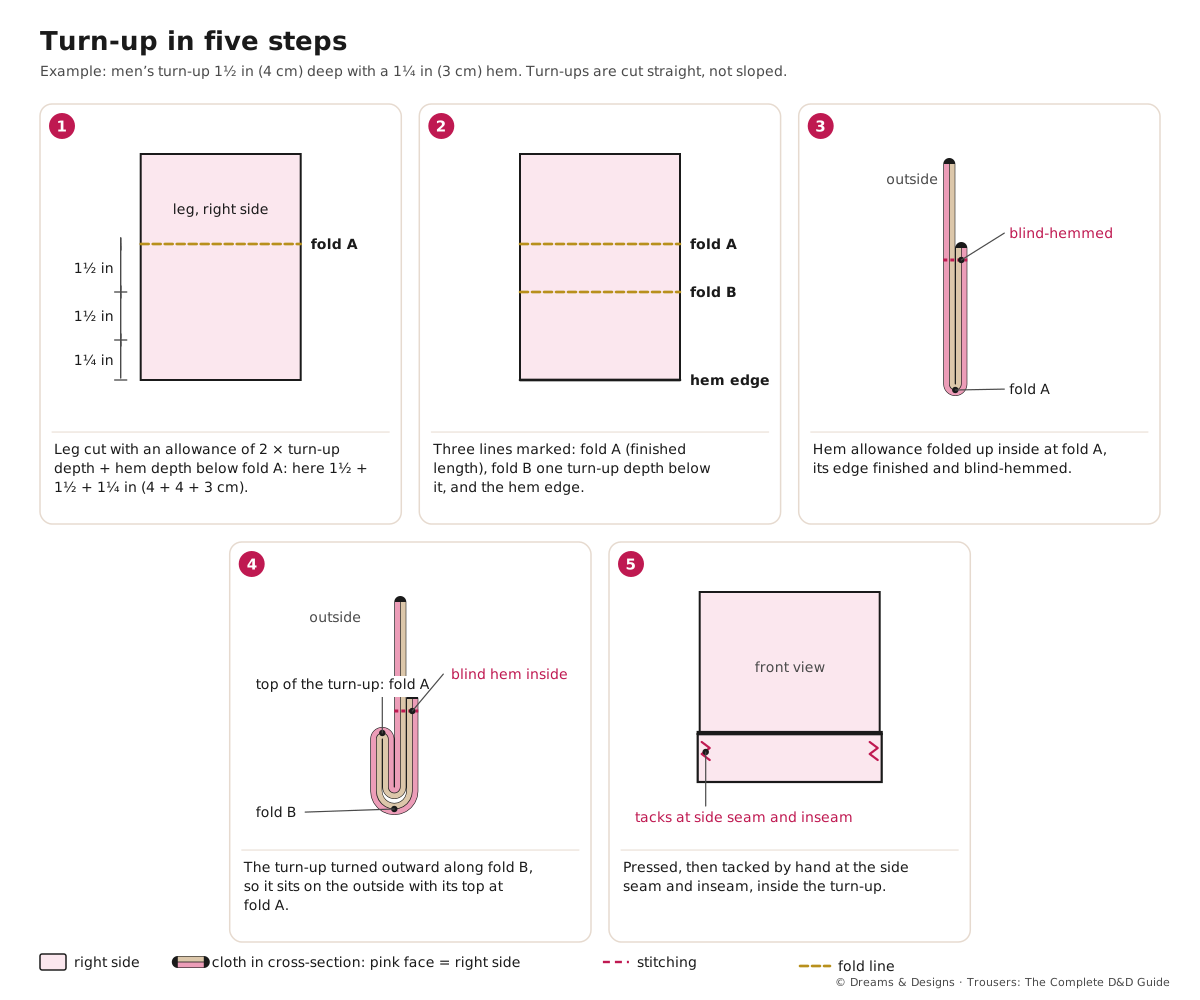
The turn-up, main steps
- Choose the turn-up depth: often 1½–1¾ in (4–4.5 cm) for men’s, 1¼–1½ in (3–4 cm) for women’s. Teacher to check.
- Cut the leg with an allowance of two turn-up depths plus a hem depth below the finished length. Do not slope the hem; turn-ups are straight.
- Mark fold A (finished length) and fold B (one turn-up depth below A).
- Fold the hem allowance up inside at fold A, finish the edge, and blind-hem it.
- Turn the cuff outward along fold B, so it sits on the outside of the leg with its top at fold A.
- Press, then hand-tack the turn-up at the side seam and inseam so it stays down. Turn-ups suit straight and slightly tapered legs; they fight with flares.
The churidar ankle, main steps
- Leave the leg seam open 3–4 in (8–10 cm) above the hem (the opening must let the foot through the narrow ankle).
- Face both edges with a 1 in (2.5 cm) strip; let one side extend as an underlap.
- Finish the ankle edge with a narrow facing or a straight band.
- Close with 3–5 small hooks and thread loops, or tiny buttons and loops.
- The churidar’s extra length above the ankle gathers into soft folds (churis) when worn.
Teacher to check: a standard, widely taught method, in inches with cm.
Before you start
- Prerequisites: Hems: blind, topstitched and faced; Button plackets and side openings.
- Time: turn-ups 45 minutes; churidar ankles 45–60 minutes; growth hem 20 minutes.
- Difficulty: moderate.
- Tools: hem gauge, hooks and eyes, buttons and loop turner, hand needles.
- Planning: turn-ups and growth hems must be added to the pattern before cutting.
Step by step: the salwar ankle band (mohri)
- Measure round the foot at its widest (heel to instep) so the band slips on; add a little ease. Typical adult band 13–16 in (33–40 cm) round; teacher to check.
- Cut a band twice the finished depth plus allowances; interface half if the cloth is soft.
- Gather or pleat the salwar leg to the band’s length (Patiala salwars have pleats here).
- Join the band into a loop; sew it to the leg, right sides together; fold over and stitch in the ditch.
- Decorate with lace, piping or embroidery if wanted, before attaching.
Step by step: raw edges and growth hems
Deliberate raw edge (denim and casual cotton):
- Cut the leg exactly at the finished length, on a straight line.
- Sew a row of straight stitching 1/2–3/4 in (1.2–2 cm) above the edge; it stops fraying going further.
- Wash and dry to start the fray; brush gently with a stiff brush for more.
Growth hem (children):
- Add an extra 2–3 in (5–8 cm) to the hem allowance on the pattern.
- Fold it up as a deep hem; blind-hem or topstitch only at the top.
- Press the fold lightly, so the crease will not show later.
- To let down: unpick, press out the old fold (with a damp cloth), and re-hem. A trim, or a band of contrast cloth, can hide any old fold line.
- Alternative: a growth tuck: a horizontal tuck sewn inside the leg above the hem, unpicked later. Common on children’s trousers; teacher to check.
Variations, and left-handed notes
- Mock turn-up: a separate band sewn on at the hem; uses less cloth.
- Elastic ankles: joggers, harem and children’s trousers; a casing or band like the elastic waist.
- Split hems: a slit at the side seam, faced and mitred; on cropped women’s trousers.
- Churidar with zip: a small invisible zip at the ankle instead of hooks; faster to wear.
- Roll-up tab: a button tab inside the leg that holds a rolled hem up (cargo and travel trousers, children’s).
- Left-handed: hand-sew loops and hooks from left to right; a left-handed wearer may want the churidar opening on the other side of each ankle. Ask.
Planning and control
- Turn-ups: mark length with shoes on, then cut; turn-ups cannot be sloped.
- Churidar: cut on the bias; leave the leg longer than the body by the amount of churis wanted, often 6–12 in (15–30 cm). Try on before finishing the ankle.
- Growth hems: record the let-down amount on the child’s order card.
Hem choices for women, men and children
- Women: turn-ups on straight and wide tailored trousers, ankle slits on cropped trousers, faced or narrow hems on palazzos, churidar ankles with kurtas, mohris on salwars.
- Men: turn-ups on formal and vintage trousers; plain blind hems on suits for weddings and office; raw or topstitched hems on jeans; mohri bands on Pathani salwars.
- Children: growth hems or tucks on every trouser, roll-up tabs, elastic ankles on joggers; no hooks at the ankles for young children.
- Festive: embroidered or lace-trimmed mohris; sew trims on while the band is flat.
Step by step: a growth tuck
- Decide the extra length, often 1–1½ in (2.5–4 cm); add twice that to the leg pattern above the hem. Teacher to check.
- Mark two lines across the leg, the tuck depth apart.
- Fold the leg on the inside so the lines meet; stitch along them with a long stitch.
- Press the tuck downward, inside the leg.
- When the child grows, unpick the tuck and press out the fold.
Tips, tricks and hacks
- Tack turn-ups at both seams so they do not fall in the wash.
- Use thread loops, not metal eyes, at churidar ankles; they lie flatter and do not scratch.
- Test the foot through the churidar opening before sewing hooks.
- Interface the mohri lightly so it stays crisp.
- Stitch above a raw edge to control fraying.
- Press growth hems lightly, never sharply.
- Use contrast bands to lengthen children’s trousers; they look intended.
- Turn-ups add weight and help light wool trousers hang.
- Plan hem decoration (lace, Kasuti borders) before the leg is closed.
- Mark fold lines with thread tacks on wool turn-ups.
- What professionals do differently: they leave enough cloth for turn-ups to be removed later, and tack them invisibly from inside.
Problems and how to fix them
The turn-up flips down
- Tack firmly at both seams.
- Press the folds with steam and a clapper.
- Prevention: tack as standard.
The turn-up is uneven round the leg
- Re-mark folds with a gauge and refold.
- Check the hem line is straight.
- Prevention: mark both folds with thread tacks.
The foot will not go through the churidar ankle
- Lengthen the opening.
- Add a zip.
- Prevention: test the foot before finishing.
Churidar hooks open while walking
- Add one more hook in the gap.
- Change to buttons and loops.
- Prevention: space hooks closely.
The mohri is too tight
- Recut a longer band.
- Add a small placket with a button.
- Prevention: measure round the heel and instep.
The raw edge frays too far
- Add a second row of stitching higher.
- Trim the loose threads.
- Prevention: stitch before the first wash.
The old fold line shows after letting down
- Press with a damp cloth and a little white vinegar (cotton only, test first).
- Cover with braid or a contrast band.
- Prevention: press growth hems lightly.
Beginner mistakes and myths
- Myth: turn-ups are only for old-fashioned trousers. They come and go in fashion and suit many straight legs.
- Mistake: forgetting extra cloth for turn-ups or growth hems.
- Mistake: cutting a churidar on the straight grain.
Practice drills
- Beginner: sew a growth hem on a child’s trouser.
- Improver: sew a turn-up on one trouser leg.
- Confident: finish a pair of churidar ankles with thread loops and hooks.
As a hobby, for earning, for teaching
As a hobby: decorated mohris and churidar ankles are a lovely place for embroidery.
For earning: letting down children’s trousers and finishing churidar ankles are frequent requests before festivals and school terms.
For teaching: compare a turn-up and a plain hem on the same trouser; learners see how a hem changes the look.
Care and finishing
- Brush dust out of turn-ups.
- Close churidar hooks before washing.
- Check growth hems each term.
Check yourself
- Can you work out the cloth needed for a turn-up?
- Can you finish a churidar ankle?
- Can you sew a mohri?
- Do you add growth room before cutting children’s trousers?
Quiz
- Can a turned-up hem be sloped? Answer: no, turn-ups are straight.
- Why is a churidar cut on the bias? Answer: so it stretches over the foot and forms soft folds.
- What stops a raw hem fraying too far? Answer: a row of stitching above the edge.
- How much extra goes into a growth hem? Answer: about 2–3 in (5–8 cm).
Key terms
- Turn-up (cuff): a hem folded to the outside.
- Churis: the soft folds at a churidar’s ankle.
- Mohri: the ankle band or hem opening of a salwar (Hindi/Urdu; studio to confirm local use).
- Growth hem, growth tuck: extra cloth for letting down.
- Thread loop: a hand-sewn loop used in place of an eye.
Sources and uncertain points
- Main source: D&D’s own trousers ebook, chapter 45 (cuffed and raw-edge hems), with general, widely taught practice and Indian tailoring practice.
- Turn-up depths, mohri sizes and churidar extra length are starting points. Teacher to check.