Every skin tone is beautiful, and every skin tone looks wonderful in many colours. This lesson explains undertone and depth so that you can find the colours that sit in harmony with a wearer’s own colouring. It is about harmony and the wearer’s pleasure, never about making skin look lighter or different.
What you’ll learn
- The two things that describe skin colouring: depth and undertone.
- Gentle ways to see an undertone, and why no test is perfect.
- How undertone and depth relate to colour choices.
- Why skin tone matters less for trousers than for tops, and where it does matter.
Depth and undertone
Depth is how light or deep the skin is, from very light to very deep. India alone holds every depth there is, often within one family.
Undertone is the quieter colour beneath the surface, which stays the same whether the skin is tanned or not:
- Warm: a golden, peachy or yellow cast.
- Cool: a pink, red or bluish cast.
- Neutral: a balance of both.
- Olive: a soft green-grey or green-gold cast, common across South Asia, the Mediterranean, the Middle East and Latin America. Olive is often described as a neutral-warm undertone.
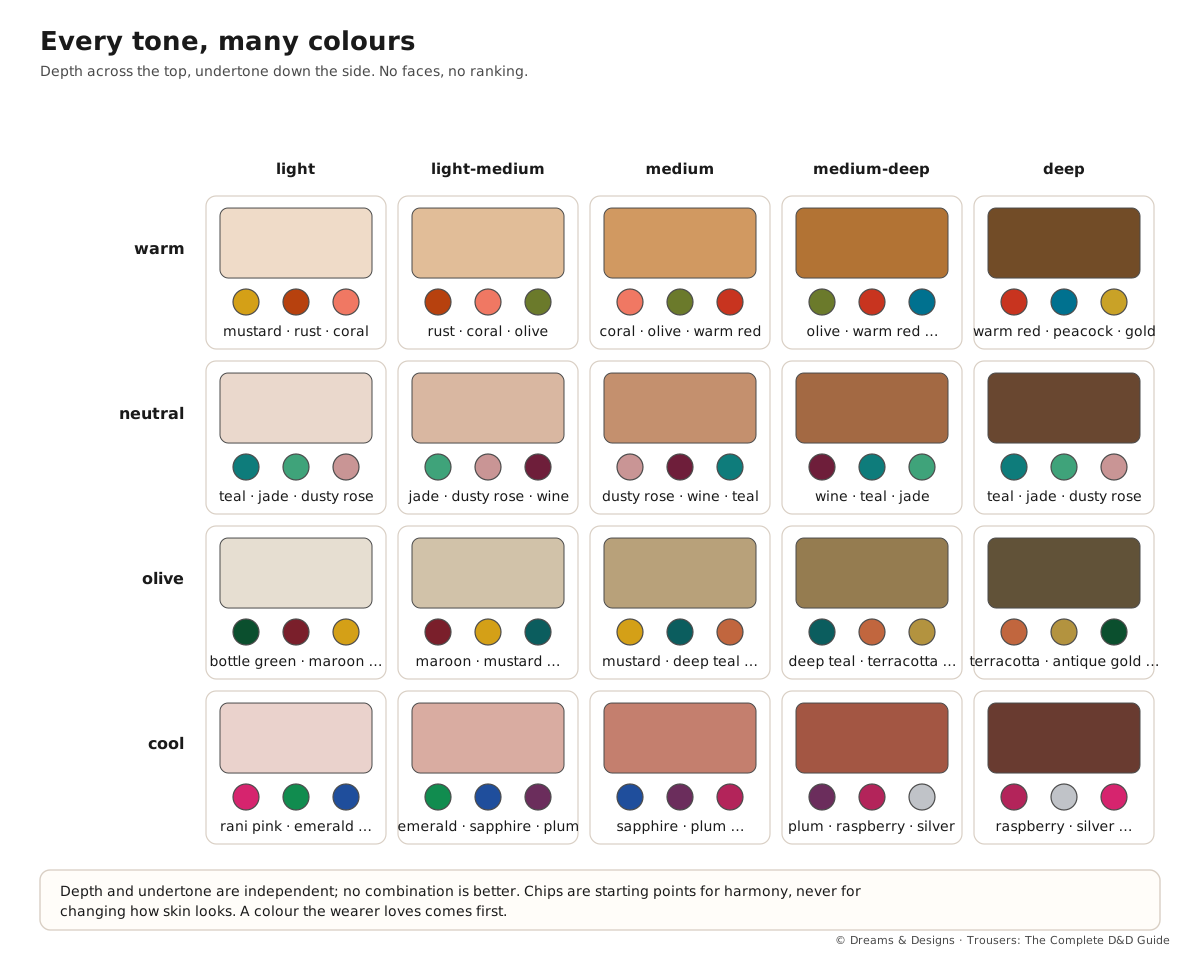
Depth and undertone are independent. Deep skin can be warm, cool, neutral or olive; so can light skin. There is no “better” combination, only different ones.
Gentle ways to see an undertone
Try two or three of these in daylight, with a clean face and no coloured cloth near it. If the results disagree, the wearer is probably neutral.
- White and cream: hold pure white cloth and then cream cloth under the chin. Cool undertones often glow with pure white; warm with cream; neutral with both.
- Gold and silver: which metal does the wearer reach for? Warm undertones often prefer gold, cool ones silver, neutrals either. It is only a tendency.
- Two drapes: hold a warm colour (coral, mustard) and then a cool one (raspberry, teal) near the face. Notice which makes the face look rested and even.
- The vein test (green veins warm, blue veins cool) is popular but unreliable, and depends on light and skin thickness. Treat it as a hint only.
What it means for colour
| Undertone | Often harmonious | Neutrals that sit well |
|---|---|---|
| Warm | Mustard, rust, coral, olive, warm red, peacock, gold | Cream, camel, chocolate, khaki |
| Cool | Rani pink, emerald, sapphire, plum, raspberry, silver | Pure white, grey, navy, charcoal |
| Neutral | Most mid-saturation colours: teal, jade, dusty rose, wine | Almost all |
| Olive | Bottle green, maroon, mustard, deep teal, terracotta, antique gold | Ivory, taupe, olive, navy |
Depth adds a second guide: a colour of similar depth to the skin gives a soft, blended look; a colour of contrasting depth (very deep skin with ivory, or light skin with navy) gives a crisp, striking look. Both are beautiful. The next lesson, Skin, hair and eye contrast for women, men and children, takes this further.
Trousers sit far from the face, so for most outfits skin tone matters far less for the trouser than for the top, kurta, dupatta or shirt collar. It matters where skin and trouser meet: a bare ankle with a cropped trouser, a midriff with a high-waisted palazzo and a short choli, or a trouser close to the colour of the skin, which reads as bare from a distance.
In more depth: why “wear any colour” is also true
- Every hue has a version for every undertone. A warm-undertone wearer who loves pink can choose coral or salmon pink; a cool-undertone wearer who loves yellow can choose lemon rather than mustard.
- Distance helps. A colour that is not a perfect harmony can be worn below the waist, with a harmonious colour near the face. Trousers are the easiest place to wear any colour at all.
- Confidence and comfort count. A colour that the wearer loves and feels good in will usually look better than a “correct” one she dislikes.
- Undertone does not change with a tan, but depth does. Some people find their favourite colours shift a little between monsoon and summer.
- Professional scales: the Fitzpatrick scale used by dermatologists describes how skin reacts to sun, not which colours to wear. Some technology firms now publish wider tone scales (for example the ten-step Monk Skin Tone scale, reported from 2022) to make cameras and products fairer. Neither is a style guide.
How to talk about skin tone respectfully
- Say “harmony”, “glow”, “sits beautifully”, “brings out your colouring”. Never “brightens”, “lightens” or “makes you look fairer”.
- Never suggest a colour because it will “hide” anything. No skin tone and no body is a problem.
- Do not guess a customer’s undertone aloud from across the counter. Offer the two-drape test and let the customer see for herself or himself.
- Avoid linking skin tone to region, caste, community or class. Every community holds every tone.
- Children hear everything. Never comment on a child’s skin tone; talk about colours the child loves.
- If a customer uses fairness language, gently move the talk back to harmony and what she enjoys wearing.
Tips, tricks and hacks
- Daylight only: undertone tests under tube lights or yellow bulbs mislead.
- Bare face, plain top: a coloured top or make-up changes what you see.
- Use the customer’s favourite dupatta as a starting clue; people often already own their best colours.
- Phone photo test: as the ebook suggests, photograph the wearer in two colours against a plain wall. Photos show harmony more clearly than a quick mirror glance.
- Close-to-skin trousers: beige and nude-toned trousers vary hugely; match them to the wearer’s own depth only if a “bare leg” look is wanted.
- Neutral near the face: if a loved trouser colour does not harmonise, put a harmonising colour at the neckline.
- Men: the shirt or kurta collar is the colour that matters; the trouser can be any neutral.
- Metallics: antique gold is the gentlest choice for olive and neutral undertones.
- Keep a drape kit: eight plain cloths (pure white, cream, coral, mustard, raspberry, teal, emerald, navy) are enough to test any customer.
- What professionals do differently: they look at harmony on the whole person in daylight and let the wearer decide.
Common misunderstandings
- “Deep skin cannot wear dark colours.” It can. Deep skin with navy, maroon or black gives a rich, tonal look.
- “Light skin must avoid pastels.” Pastels with light skin give a soft, blended look; that is a choice, not a mistake.
- “Indians are all warm.” India has every undertone, and olive and neutral are very common.
- “The vein test decides it.” It is unreliable; use two or three gentle tests and the wearer’s own eye.
- “Some colours are forbidden for some skin.” None are. Some colours harmonise more easily; anyone may wear anything.
For earning and teaching
For earning: a short colour consultation with the drape kit is a natural part of a bridal or festive order. It is about choosing harmonies the client loves, so keep the language warm and positive.
For teaching: pair learners to test each other with the drape kit in daylight. Ask them to describe what they see using only respectful words from the list above.
Sources and uncertain points
- Main source: D&D’s ebook, chapters 55 and 58 (colour testing), widened with general styling practice.
- Undertone categories and tests are styling conventions, not science; results differ between people and lights.
- The Monk Skin Tone scale date is reported; check before quoting it.
Check yourself
- Can you explain the difference between depth and undertone?
- Can you run the white-and-cream test and the two-drape test?
- Do you know why skin tone matters less for trousers than for tops?
- Could you suggest a pink for a warm undertone and a yellow for a cool one?
- Do you know which words to avoid when talking about skin tone?
Quiz
- Name the four undertones. Answer: warm, cool, neutral, olive.
- Does undertone change with a tan? Answer: no; depth changes, undertone stays.
- Where does skin tone matter for a trouser? Answer: where skin meets the trouser (ankle, midriff), and with close-to-skin colours.
- Is the vein test reliable? Answer: no; use it only as a hint.
Key terms
- Depth: how light or deep the skin is.
- Undertone: the steady colour beneath the surface (warm, cool, neutral, olive).
- Drape test: holding plain cloths near the face to see harmony.
- Tonal look: colours of similar depth to the skin.
- Harmony: colours that sit together pleasingly.