Bags, jewellery, belts, watches and small touches like a pocket square or a hair flower are the last levers of the look ladder. Used well, they finish an outfit; used too much, they compete with it. This lesson covers each, for women, men and children, with the stylist’s rule of three.
What you’ll learn
- The rule of three points of interest.
- Bags by trouser shape and occasion.
- Jewellery with trouser outfits, Indian and Western.
- Belts, watches and finishing touches for men; safe accessories for children.
The rule of three
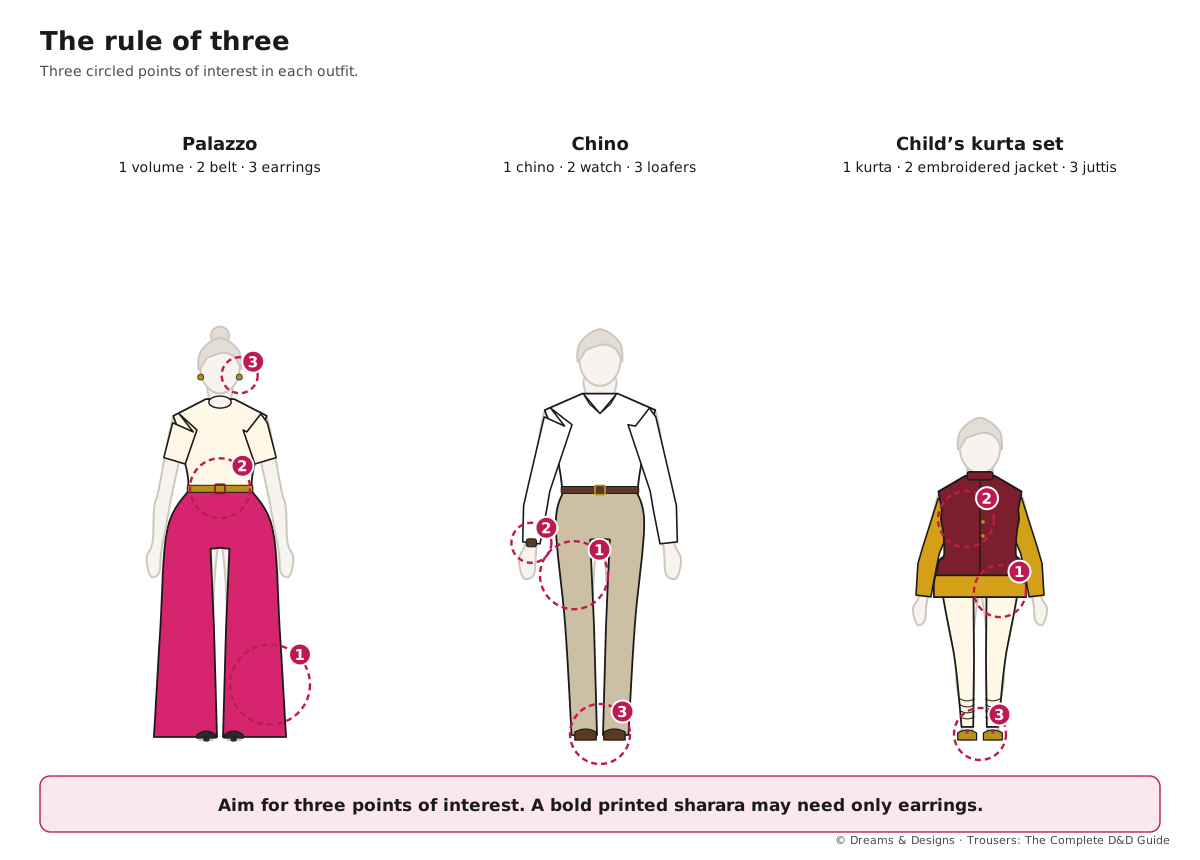
The ebook’s stylist trick: for any outfit built around a strong trouser, aim for three points of visual interest – for example the trouser’s volume, a defined waist and one accessory or colour moment. Four or more tend to compete. A plain trouser leaves room for more; a bold printed sharara may need only earrings.
Bags
- Proportion: a large tote balances wide legs and long kurtas; a small crossbody or clutch suits slim trousers and short tops.
- Where it sits: a crossbody bag at hip level adds a horizontal line at the hip; a clutch held in the hand keeps the line clear.
- By rung: cloth tote or backpack (simple, casual), leather crossbody or structured bag (smart-casual, formal), potli, box clutch or embroidered bag (festive, special occasion).
- Men: a backpack or messenger for college and casual, a leather briefcase or laptop bag for formal; a slim wallet in the front pocket keeps trouser lines clean.
- Pockets first: many people simply want good trouser pockets. Deep side-seam pockets in palazzos and festive trousers are always welcome.
Jewellery
| Outfit | Jewellery that suits | Keep in mind |
|---|---|---|
| Kurta and churidar or salwar | Jhumkas, chandbalis, bangles, a small nose pin | Heavy earrings with a simple neckline |
| Palazzo or sharara with crop top | Statement earrings, a choker, a waist chain (kamarbandh) | One focal piece |
| Office trousers and shirt | Studs, a fine chain, a watch, a slim bangle | Quiet; nothing that clinks on a desk |
| Evening trouser suit | Drop earrings, a cocktail ring, a brooch on the lapel | Echo the metal of buttons and buckles |
| Cropped trousers | Anklets (payal), toe rings | Shows only with ankle-length hems |
Metal: oxidised silver for casual and handloom looks; gold, kundan and polki for festive; pearls for formal and bridal; temple jewellery for South Indian silk. Warm or cool metals can follow the wearer’s undertone (see Skin tone and colour harmony), but the wearer’s preference comes first.
Men’s finishing touches
- Belt: leather matching the shoes for formal; woven or canvas for casual; none with side adjusters or tuxedo trousers.
- Watch: the classic men’s accessory with trouser outfits; metal or leather strap for formal, sports straps for casual.
- Kada, bracelet, ring, chain: with kurtas and casual wear; a Sikh kada is a religious article, not an accessory.
- Pocket square, brooch: on a blazer, bandi or bandhgala for festive and special occasions.
- Safa, pagdi or stole: for weddings, often provided by the family.
Children’s accessories: safety first
- Small children: avoid small detachable parts – beads, sequins, loose buttons, small brooches – that could be swallowed. Check that trims are sewn on securely.
- No cords or long chains around the neck; avoid long hanging ties and dupattas that can catch on play equipment, doors or escalators.
- Bangles and anklets should be smooth inside, and removed for sleep.
- Bags: a small backpack with both straps keeps hands free.
- See Module 1, Children’s clothing safety standards, for named standards.
Finishing touches that cost nothing
- Pressing: a crisp trouser looks a full rung higher.
- Lint and threads: clip loose threads and roll off lint before leaving.
- Clean shoes: the first thing many people notice.
- Grooming: neat hair, trimmed nails, a tidy beard or clean shave; flowers in the hair for festive.
- Fit check: sit, stand and walk in front of a mirror; adjust the waist, tuck and hem.
Tips, tricks and hacks
- Count to three before leaving: remove the fourth accessory.
- Repeat a colour: pick the bag or jewellery colour from the trouser print.
- Belt as a lever: a belt over a kurta or long shirt with slim trousers adds a waist and a new look.
- Waist chain over a sharara or dhoti pant gives a festive point without a necklace.
- Potli loops over the wrist free both hands at a wedding.
- Brooch on a bandi lifts a man’s outfit to special occasion.
- Office: silent jewellery, nothing that catches on a laptop.
- Anklets look best with cropped trousers or churidars gathered just above them.
- Children: let them choose one fun accessory; keep it safe.
- What professionals do differently: they style accessories last, after the outfit is fitted and balanced.
Common misunderstandings
- “More jewellery means more festive.” One strong piece often looks richer.
- “Gold and silver never mix.” Mixed metals are a modern, deliberate look.
- “Men do not need accessories.” A watch, belt and pocket square do real work.
- “Children’s accessories are harmless.” Small parts and cords are real hazards.
For earning and teaching
For earning: matching potlis, belts and embroidered bandis made from outfit leftovers are welcome add-ons; offer them at the order stage.
For teaching: a “rule of three” exercise: learners style one trouser outfit three ways, circling the three points each time.
Sources and uncertain points
- Main source: D&D’s ebook, chapter 58 (three-point balance), widened to Indian jewellery, men and children.
- Children’s safety points are general guidance; check current standards (Module 1).
Check yourself
- Can you explain the rule of three?
- Can you choose jewellery for a kurta-and-churidar and an office outfit?
- Do you know three men’s finishing touches?
- Can you list three safety points for children’s accessories?
Quiz
- How many points of interest does the stylist rule suggest? Answer: three.
- What jewellery suits cropped trousers? Answer: anklets (payal) and toe rings.
- What should children’s accessories avoid? Answer: small detachable parts, cords and long hanging pieces.
Key terms
- Jhumka: a bell-shaped earring.
- Chandbali: a crescent-moon earring.
- Kamarbandh: a waist chain or belt.
- Payal: an anklet.
- Kada: a thick bangle; the Sikh kada is a religious article.
- Potli: a drawstring pouch bag.