Beyond embroidery, a trouser can be decorated with things that are sewn, set or hung on it: beads and sequins, mirror work, gota patti, appliqué and patchwork, lace, piping, studs, patches, fringes and latkans. Each has its own weight, sparkle and wear. This lesson describes each, shows where it sits best on a trouser, gives a full method for lace insertion and a gota hem, and sets out the safety rules for children’s wear.
Teacher to check: allowances and spacing are starting points.

What you’ll learn
- What each embellishment adds, and where it sits best on a trouser.
- How to insert lace into a trouser leg.
- How to apply a gota patti hem.
- Safety rules for children’s wear, and care.
The embellishments
| Embellishment | Adds | Best places |
|---|---|---|
| Beads and sequins | Sparkle, weight | Hem bands, waistbands, knee bands |
| Mirror work (shisha) | Flashes of light | Hem, mohri, side panels |
| Gota patti | Metallic shine, crisp edges | Hems, borders, motifs on festive wear |
| Appliqué and patchwork | Colour, shape, reuse | Knees, pockets, all-over panels |
| Lace and lace insertion | Lightness, see-through bands | Hems, knee bands, side stripes |
| Piping | A crisp line | Seams, pocket edges, waistbands |
| Studs and rivets | Strength, edge | Pocket corners, yokes |
| Patches | Story, repair | Knees, seat (repair), thighs |
| Fringes and tassels | Movement | Hems, side slits |
| Latkans | Movement, tradition | Nada ends, side slits, waist ties |
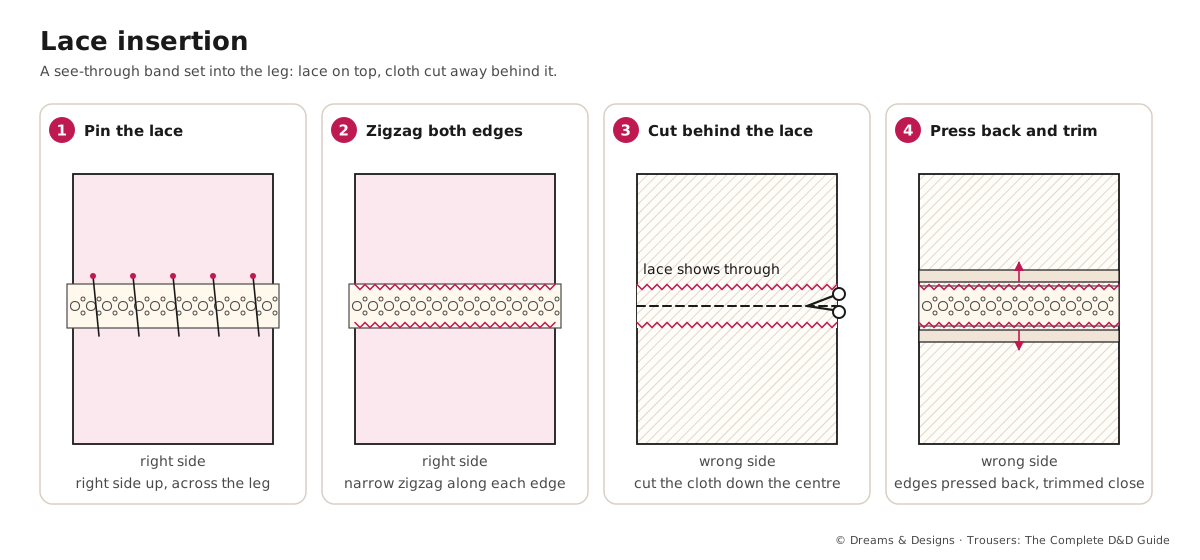
Lace insertion, step by step
- Mark the line on the leg piece (flat, before side seams). Keep it on grain or follow a design line.
- Pin the lace on the right side, along the line.
- Stitch both edges of the lace with a narrow zigzag or a straight stitch.
- Cut the cloth behind the lace down the centre, from the wrong side, taking care not to cut the lace.
- Press the cloth edges back away from the lace and stitch them again, or trim close to the zigzag.
- Finish the raw edges with a narrow zigzag. Press from the wrong side.
A gota patti hem, step by step
- Hem the trouser first (or plan the gota to cover the hem stitching).
- Mark a line the gota’s top edge will follow, measured from the hem.
- Pin gota along the line, turning the cut end under at the inseam.
- Stitch both edges by hand with small hem stitches, or by machine with a fine needle and matching thread.
- For gota motifs (patti): fold gota ribbon into leaves and shapes, tack in place, and hem the edges; add small embroidery to finish.
- Press lightly from the back with a cloth; metallic gota can mark under a hot iron.
Each embellishment in more depth
- Beads and sequins: sew with a doubled, waxed thread; secure every few beads so a broken thread loses only a few.
- Mirror work: small mirrors held by a framework of stitches; traditional in Kutch, Rajasthan and Banjara work. Ready-framed mirrors are quicker.
- Gota patti: metallic ribbon appliqué, traditional in Rajasthan; modern gota is often polyester-based metallised ribbon, lighter and cheaper than older metal-thread gota.
- Appliqué: shapes of cloth sewn on top; Pipli in Odisha and Barmer in Rajasthan are known centres. Reverse appliqué cuts away the top layer to show the one below.
- Patchwork: pieces joined into a new cloth; a natural partner to zero-waste cutting.
- Piping: a folded bias strip, with or without cord, set into a seam.
- Studs and rivets: metal fittings set with a press or tool; jeans traditionally use rivets at pocket corners.
- Patches: woven, embroidered, iron-on; for decoration or repair.
- Fringes and tassels: bought or made from the cloth’s own threads.
- Latkans: decorated tassels, beads, shells or fabric balls at the ends of the nada; see Elastic, nada, latkans and drawstrings.
Children’s safety
- Under three years: no beads, sequins, mirrors, studs or small buttons that could come off and be swallowed. Flat appliqué, piping and embroidery only.
- All children: no long cords or tassels at the waist or hem; latkans short and firmly attached, or none.
- Check strength: pull every attached item firmly; anything that moves is reattached.
- Standards: children’s clothing safety standards cover small parts and cords; see Children’s clothing safety standards and check current requirements before selling.
Before you start, and what you need
- Prerequisites: hand sewing, zigzag stitching, hemming.
- Time: from an hour (piping a pocket) to days (a beaded hem).
- Difficulty: beginner (patches, piping), intermediate (lace insertion, gota), advanced (mirror work, beading).
- Materials: lace, gota, beads, sequins, mirrors, piping cord, bias strips, a beading needle, a stud press.
- Budget: fabric scraps for appliqué; self-fabric piping.
Where you see these in Indian fashion
- Gota patti on festive palazzos, shararas and lehenga-style trousers.
- Mirror work on navratri and festive wear, especially from Gujarat and Rajasthan.
- Latkans on nearly every festive salwar.
- Lace and piping on churidar and palazzo hems.
- Patches and studs in denim and street wear.
Women, men and children
- Women: every embellishment is used; festive wear combines several.
- Men: piping, subtle patches, rivets; mirror work and gota on dance and festival wear.
- Children: appliqué and patches are favourites; follow the safety rules.
Tips, tricks and hacks
- Sew trims before the side seam so ends hide in the seam.
- Use a glue stick to hold appliqué before stitching.
- Wax beading thread for strength.
- Pre-wash lace and trims; they can shrink.
- Keep heavy trims above the hem fold so the hem still hangs.
- Use self-fabric piping for a quiet line, contrast for a bold one.
- Test stud strength on a scrap of the same cloth.
- Professionals sew beads in short sections, tying off every few inches.
- Turn fringes from the trouser’s own fabric by pulling weft threads.
- Remove trims before alterations, and sew them back after.
Problems and how to fix them
1 · Lace edge pulls away
- Re-zigzag wider.
- Add a second stitching line.
- Prevention: stitch both edges before cutting behind.
2 · Gota puckers
- Unpick and re-pin with less tension.
- Steam lightly from the back.
- Prevention: lay gota flat without stretching.
3 · Beads fall off
- Re-sew with doubled thread.
- Tie off every few beads.
- Prevention: wax the thread.
4 · Mirrors crack
- Replace the mirror inside the old stitch frame.
- Replace with a sequin.
- Prevention: hand wash; avoid wringing.
5 · Appliqué edges fray
- Satin-stitch the edges.
- Fuse the back.
- Prevention: turn edges under or use non-fraying cloth.
6 · Studs tear the cloth
- Back the area with interfacing and re-set.
- Patch over the hole.
- Prevention: interface before setting.
7 · The hem drops under heavy trim
- Add a hem facing.
- Move some trim higher.
- Prevention: balance trim weight with the cloth.
Beginner mistakes and myths
- Mistake: putting beads on a toddler’s trousers.
- Mistake: pressing metallic trims with a hot iron.
- Myth: “More trim is more festive.” One rich band often looks finer than five.
- Myth: “Patches are only for repair.” They are design too.
Practice drills
- Beginner: pipe a pocket edge; appliqué a child’s knee patch.
- Intermediate: insert lace into a palazzo leg; apply a gota hem.
- Advanced: a mirror-work and bead band on a festive trouser.
As a hobby, for earning, for teaching
As a hobby: trims transform shop-bought trousers fast.
For earning: festive embellishment on trousers and salwars is steady studio work before weddings and festivals.
For teaching: a trim sampler (piping, lace insertion, gota, appliqué) is an excellent workshop.
Care and finishing
- Hand wash or use a laundry bag; dry flat.
- Iron from the back on a towel; never iron beads, mirrors or foil.
- Store festive trousers wrapped in muslin, away from damp.
Sources and uncertain points
- General craft knowledge and studio practice.
- Pipli appliqué is reported to hold a GI registration; check before quoting.
- Composition of modern gota varies; check with the supplier.
Check yourself
- Can you place five embellishments on a trouser?
- Can you insert lace cleanly?
- Can you apply a gota hem without puckers?
- Can you list the safety rules for children’s embellishment?
Key terms
- Shisha: mirror work.
- Gota patti: metallic ribbon appliqué.
- Lace insertion: lace set into a garment with the cloth cut away behind.
- Reverse appliqué: cutting away a top layer to show the layer below.
- Rivet: a metal fitting at a stress point.